Our gaming here is heavily shaped by a couple of factors. One is that we quite like cooperative games. Another is that we pay way too much attention to Kickstarter. Some of the games we've backed, notably Burgle Bros., have been excellent additions to our gaming collection. So today, a new box showed up on our doorstep. How was it? Well...
5 Minute Dungeon from Wiggles 3D is a cooperative dungeon-themed card game. Two to five players have five minutes to work through a series of monsters and other challenges to finally face off with a boss monster. There's actually a series of bosses, so a full round of them can theoretically be accomplished in about a half hour.

Each player chooses one from among ten different adventurers: the sorceress, the barbarian, the valkyrie, the ninja, and so on (for those who care about such things, the gender mix is evenly split between male and female). Each adventurer has their own deck of cards (which, by the way, are flexible enough to shuffle easily right out of the box; other games we've played have had stiffness issues, so that's nice to have). Most of them are cards representing different kinds of resources used to defeat monsters: swords, shields, arrows, scrolls, and leaps. Each adventurer has its own mix of cards. The sorceress and wizard have more magical scroll cards, for example, while the huntress and ranger have more arrow cards. Each deck also has its own special cards unique to the adventurer, which may act as "wild card" resources, let people draw more cards, automatically defeat certain kinds of foes, and various other things. And each adventurer has an inherent special ability, usually allowing him to discard three cards in order to make something happen, such as automatically defeat a specific type of challenge, pause game play, or allow a larger number of cards to be drawn.

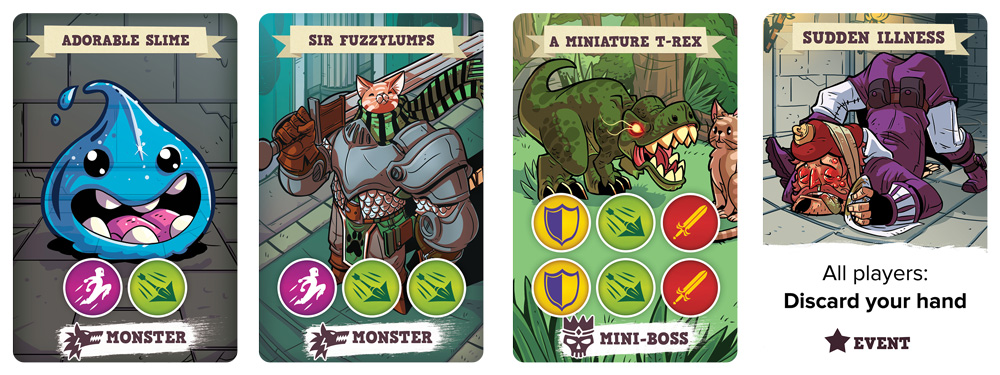
Facing the adventurers, there's a deck of "Door" cards, each representing a monster, a trap, or some such staple of dungeon-crawling adventure. The card lists a class and has icons indicating the number and type of resources necessary to defeat it. For example, the Adorable Slime is a Monster (as opposed to an Obstacle, Person, or Mini-Boss) listing a leap and an arrow to beat. The players must among them come up with a leap resource card and an arrow card to defeat it, or some other card or ability which automatically defeats monsters. When a door card is defeated, it and the cards used to beat it are put aside and another door card is drawn. When the entire deck of door cards is defeated, the players then have to take on the boss, which requires its own mass of resource to beat. There are five bosses in the regular game, or seven in the Kickstarter edition, of graduated levels of difficulty.
There are two dimensions of difficulty for a boss. One is the resources needed to beat it. The other, which is more significant in my mind, is the size of the door deck. Each boss specifies the number of door cards to use with it, ranging from 20 for the Baby Barbarian to 50 for the Dungeon Master (Final Form). That number is significant in a couple of ways. One is that the cards used to defeat monsters are removed from play (though not those used to power adventurers' special abilities; those can be recycled into the player's hand or deck in various ways), so a thicker door deck means fewer cards left to use to beat the boss. The other is that the game is timed. You've got five minutes to burn through the door deck and then beat the boss, and that five minutes goes by a lot faster than you think it will.
For that reason, game play is more than a little frantic, and that's a good thing. Like another game I'm fond of, Escape: The Curse of the Temple, there are no turns. It's just everybody playing as fast as they can to get through in the time allotted. But despite the shorter time limit (5 as opposed to 10 minutes), 5 Minute Dungeon is better at being fast-paced fun rather than full-on panic.
I have only two criticisms of the game worth noting. The first is that an important rule isn't clearly stated. The first time we played, we shortly found ourselves facing a monster against which we had no cards we could play. We were stuck. It turns out that you can play resource cards which will have no effect. That gets the cards out of your hand, allowing you to draw new cards to replace them. The rules don't say that you can do that; the closest they come is saying that you can't do that against bosses. The clear implication (confirmed over on BGG) is that you can play ineffective cards to get your cards moving, but you have to be in a somewhat lawyerly state of mind to pick up on that. However, with that out of the way, it was smooth sailing.
The other is somewhere between a criticism and an ironic observation. The game requires a lot of focus. You have to see if new door cards are subject to your adventurer's ability, manage the contents of your hand, make sure you're drawn up to as many cards as you should have, and keep an eye on the clock. And while you're doing this, you have absolutely zero time to appreciate the cards. And that's a real pity, because they do a lot to add to the atmosphere of the game. The art is nicely cartoony and the contents very funny (don't quote me on this, but I just bet that the designer had access to the internet at some point); this is a dungeon crawl less like Planescape: Torment and more like Munchkin. They set a tone, but you just don't have a moment to spare to notice them when they're whizzing past. You'll probably need to do what we did, which is to look over them before or after the game, not during.
So, then, this is a game well worth having if you're looking for something short and exciting rather than long and contemplative. It does work with two player, but gets better with more. It's easily learned and is probably a good bet for a casual game with usually non-gaming friends, who don't have to worry about complex rule or elaborate strategies. Several stars out of perhaps one or two more stars than that, a number of tentacles up. It appear to be exclusive to Kickstarter at the moment, but keep an eye out for resellers and grab it before the price goes up.
Comments